The Rare Review

Movies, books, music and TV

The Unbeautiful Arises: The Film, “American Beauty”

American Beauty (film)

American Beauty (film) (Photo credit: Wikipedia)

American Beauty (1999) is about a discontent suburbanite whose go-getter wife and truculent daughter disdain him, and who falls in love with his daughter’s beautiful best friend.  It involves some other folks too, among them a harsh Marine officer who is a repressed homosexual.  Whoa!  Bad idea, you say?  Yes, it is; as hoary as it is cheap.  The Marine’s homophobia is frowned on, his “reactionary” love of discipline scorned.  He must be made to pay.  Curiously, however, his dope-pushing, dope-smoking son receives the filmmakers’ sympathy (though, in fairness, his father receives some too)  and is never made to pay.

Homosexuality, though, is not a major subject here.  Heterosexuality is.  The heterosexual lives, that is, of the characters played by Kevin Spacey (the discontent suburbanite), Annette Bening, Thora Birch, et al.  While watching the film I thought another subject it was about was the folly of the American dream, but not exactly.  It makes the point that this dream is not such a folly after all, that it is perhaps . . . one of the beauties of America?  In my view the beauty of the American dream goes only so far, but in any event, whatever is being said, the movie’s conclusion doesn’t cut it: it’s both rosy and stupidly implausible.  It doesn’t convince us of the goodness of the American dream.  It merely confirms that the film has gone awry.

Though deeply blemished, American Beauty does have its assets.  What with Sam Mendes‘s bright direction, Conrad Hall’s flawless cinematography, and Thomas Newton’s eccentric yet restrained music, it tries to be art.  Many images are superbly sensuous, and not just the sexy ones.  The technicians here knew what they were doing; the screenwriter, Alan Ball, didn’t.  His script’s profundity is nil.

If you want an inoffensive, non-tendentious opus about an unhappy married man who falls for a teenage girl, read John Cheever’s story, “The Country Husband.”  It is five times as appealing as American Beauty, for all its dandy visuals.

Quality “Kwai”: “The Bridge on the River Kwai”

The Bridge on the River Kwai

The Bridge on the River Kwai (Photo credit: Wikipedia)

The Bridge on the River Kwai (1957), by David Lean, is a film of elevations.  People move around on top of mountains, banks, bridges; and there are shots of the sky above treetops.  Natural (and manmade) grandeur is frequently close to where men are working and warring and suffering.

Lean has a perfect sense of this grandeur, while—-regrettably—his film is weak in characterization.  Colonel Nicholson (Alec Guinness) and the soldier Shears (William Holden) seem like prototypes of something but not much more, and so they’re obscure.  However, it is fine for the picture to ask what is and what is not insanity in war, and to point out the insanity of helping the enemy: the Japanese army in WWII.

A British-American effort filmed in Ceylon, Bridge is Lean’s first epic.  It’s not necessarily one of his best movies, but it shares with his other works the benefit of unmistakable art.

Forcefully Funny: “Fatty’s Tintype Tangle”

If you like the film comedies of the silent era, you should try the Roscoe “Fatty” Arbuckle short, Fatty’s Tintype Tangle (1915), directed and starred in by the comic actor.

Arbuckle is forcefully funny and entrancingly winsome as the harried Fatty, who is driven to maniacal behavior by his shrewish mother-in-law.  Worse than she, however, is the monster of Misunderstanding, arising in the minds of not only the two women in Fatty’s life but also the jealous husband (Edgar Kennedy) of Louise Fazenda.  Fazenda?  Yes.  Married to movie producer Hal Wallis, she was as gifted for slapstick farce as Arbuckle.

There might be too much reliance on the jealous husband’s mad gun violence in Tintype Tangle, but it’s a zippy, lurching jewel all the same.  And only 20 minutes long.

(Available on the DVD, The Forgotten Films of Roscoe “Fatty” Arbuckle.)

Joe Becomes Donnie: “Donnie Brasco”

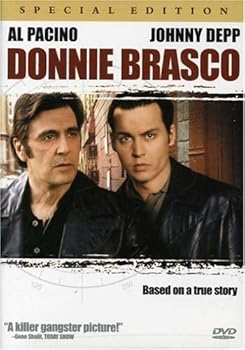
Cover of "Donnie Brasco (Extended Cut) [B...

Cover of Donnie Brasco (Extended Cut) [Blu-ray]

For an American movie, Donnie Brasco (1997) is near-great.  For a movie period, it is simply good, but of course that’s saying a lot.

Notwithstanding he made the repelling Four Weddings and a Funeral, it helps that DB was directed by the talented Mike Newell, who, together with scenarist Paul Attanasio, has borrowed for their enterprise the true story of Joseph Pistone, an undercover FBI agent who fooled and eventually ruined a formidable crime family.  A regrettable fact here is that Pistone, known by the fake name Donnie Brasco while undercover, is an almost completely unsympathetic figure, and Newell and Attanasio never quite catch on to this.  True, they wish to convince us of Donnie-Joseph’s potential for meanness and violence—the traits we see time and again in the mobsters he is working against—but they push it too far.  Happily they know what they’re doing, though, when they show Pistone at home, or at the marriage counselor’s, with his wife Maggie, and we see the ugly strain the undercover work is having on their marriage.  Everything about this is on the mark.

They know what they’re doing in other areas as well.  After quarreling with and being slapped by Pistone, Maggie (Anne Heche) is shot by Newell in closeup before a slow dissolve removes her from the screen and replaces her image with that of the streets where Pistone does his job; there is a certain poignancy to it.  The contrast between the gangsters’ nasty doings in New York City and their amusements on the beach and at a motel swimming pool in Miami leaves its mark on the mind, as does the excellent sequence in which Al Pacino, Michael Madsen, and another fellow, all gangsters, have just been told by the FBI of Donnie’s being an undercover agent and they are uncertain and bewildered as they stand outside a pool hall.

The acting is thrillingly effective—that of Johnny Depp (Pistone) less so, however, than that of Pacino, Heche, and others.


Radiation Sickness In “Black Rain,” The Movie

Cover of "Black Rain"

Cover of Black Rain

Japan’s Black Rain (1988) is about disease.  And Hiroshima.  The disease is radiation sickness, ergo the cause is the bomb.

The film begins on August 6, 1945, when Hiroshima got it in the neck, and a more horrid city catastrophe you will not find in a movie, albeit to his credit director Shohei Imamuri does not rub our noses in it.  Several screen minutes later, it is 1950 in a prosaic Japanese village; inhabitants live their quiet lives there.  But, tragically, many of these inhabitants were in or near Hiroshima five years ago, and some are getting ill.  The film’s narrative, adapted from a novel by Masuji Ibuse, is pivoted on an aunt’s and uncle’s efforts to marry off their 25-year-old niece Yasuko (Yoshiko Tanaka), about whom there are village rumors that she too is ill.  The aunt and uncle have radiation sickness, but what of Yasuko, who was never actually in Hiroshima?  Are the aunt and uncle lying to themselves in thinking their niece may be physically fit for marriage?

For two full hours Black Rain gives us much to see and a goodly amount to think about.  It is reticently angry, hating the weapons of warfare (with no vicious Japanese soldiers appearing); it is bleak and compassionate.  Some of the finest scenes include the one where, outside Hiroshima in a boat on a river, Yasuko’s young face gets spattered by the titular “rain” that is the result of the awesome explosion.  And the one where Yasuko’s aunt, so sick she is hallucinating, imagines she sees four men whom radiation sickness has already killed brazenly opening the windows of her home.  Too, a semi-charm emerges in the scene where a brash young man kisses and tells Yasuko that he loves her (before losing his balance on a pile of rocks he is standing on), but no charm at all can be found—of course—when, some time later, Yasuko examines her face in a mirror, looking for evidence of the malady.  And does she think she sees it?

Imamura has done superlative work here.  Since I haven’t read Ibuse’s novel, I can’t say whether the film does justice to it but it immediately makes you suspect that it has.  One takes pleasure in being unable to detect hardly any artistic flaws at all, certainly no serious ones.  It reminds us of the greatness of the most skillful Japanese films.

Page 208 of 317

Powered by WordPress & Theme by Anders Norén