
Blake Edwards‘s Experiment in Terror (1962) is about a bank teller (Lee Remick) forced by a murderer to rob her place of employment. A vivid thriller, it is very much a police drama—with Glenn Ford‘s John Ripley on the case—which somewhat anticipates Klute, The French Connection and Dirty Harry. Edwards did some admirable directing here and got some scary lighting from cinematographer Philip Lathrop. There is beauty (and decent acting) from Remick, sexiness from Stefani Powers as the bank teller’s younger sister.
Category: Movies Page 13 of 49
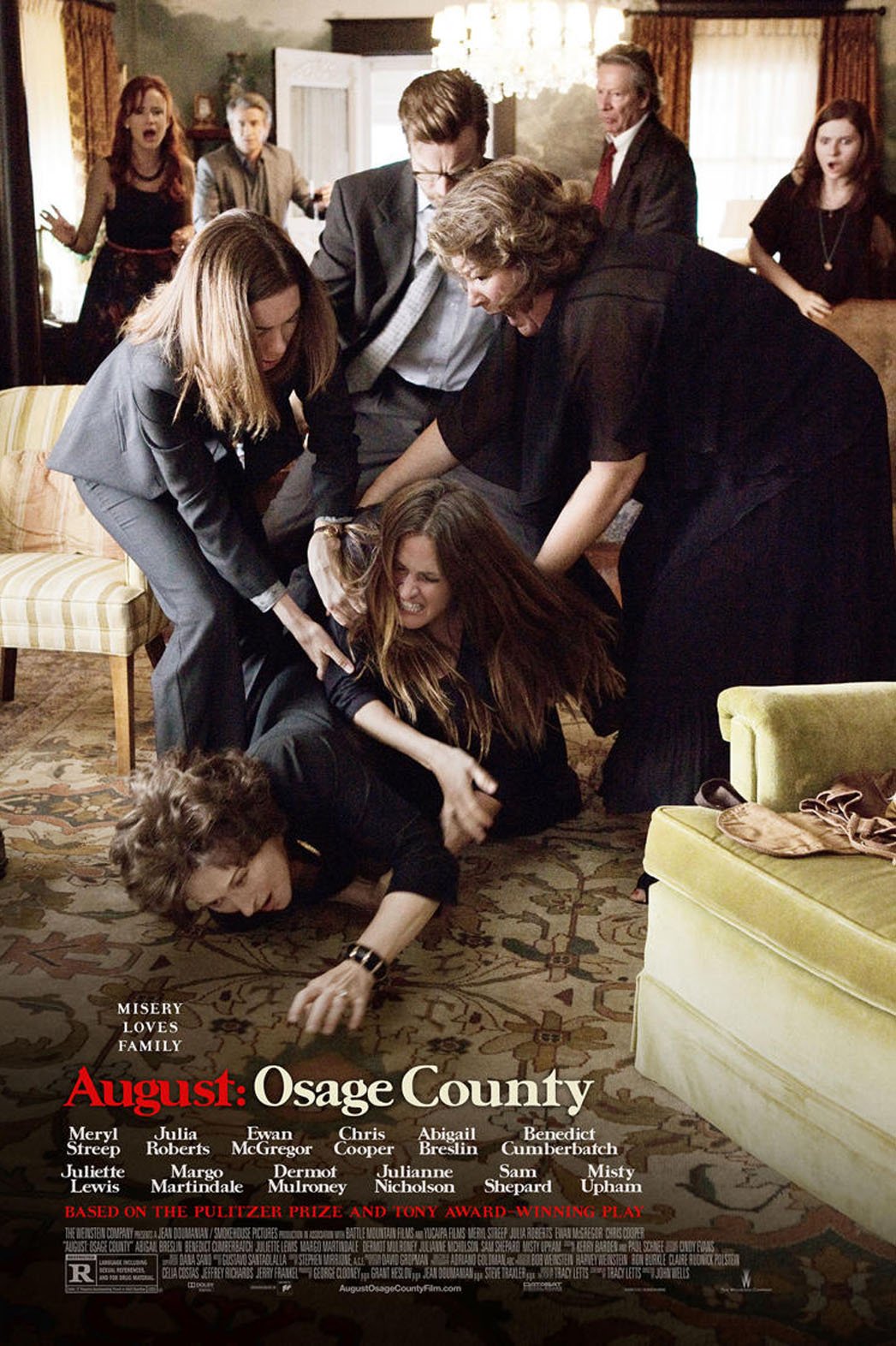 A true sense of tragedy intermittently comes through in August: Osage County (2013), the John Wells film of Tracy Letts’ play, as the troubled Oklahoma characters blow it big-time. Successfully Letts adapted it, confidently Wells directed it.
The complaint has been made that the movie contains too much Meryl Streep (as the ranting, pill-addicted Violet Weston). I’d say that considering the thoughtful, unself-conscious magnificence of Streep’s performance, she has exactly the right amount of screen time. Julia Roberts is stunningly impeccable as a candid and discontent wife and mother, while Margo Martindale is very good at making Violet’s sister complex.
Chris Cooper delights with common-man qualities, but the British actor Benedict Cumberbatch, for all his effort, is not meant for the role he was given. Julianne Nicholson and Juliette Lewis are engaging enough that we miss them after they drop out of the film. (I do, anyway.)
Wells’s movie was made a lot closer to where I live, which is OK’s Tulsa County, than other movies are. It’s a funny-bleak work not without faults, but whose acting means a lot and is not to be underrated.

In the 1977 Fun with Dick and Jane: “When a successful, middle-class couple finds themselves unemployed and in debt, they turn to armed robbery in desperation” (imdb.com).
Virtually the only reason I watched this comic film was to check out Jane Fonda‘s usually excellent acting. And excellent it is, though that of George Segal is also very effective. Both actors are terrifically grounded. However, three screenwriters —especially Jerry Belson, who penned Michael Ritchie’s Smile—should have engendered a sturdier script. I don’t like the movie’s loose morality, but it’s nearly irrelevant in light of the screenplay’s thorough self-destruction. Although it has its moments, it’s a movie of much hokum and, for bad measure, no personal vision. Director Ted Kotcheff is not known for the latter. But Belson provided it in Smile.
Judy Greer is pleasantly persuasive as Grace, a Christian wife and mother, in a mostly successful Christian comedy, The Best Christmas Pageant Ever (2024). I’m unfamiliar with the 1972 novel it’s based on, but reportedly the movie’s jokes are those in the book and it was wise of the filmmakers to retain them. They’re sufficiently funny.
Grace is central to the story but so is young Imogene (Beatrice Schneider), the atrociously behaved sister of several atrociously behaved siblings. What goes on with her, finally, smacks of conversion, maybe of future conversion. The kid actors are winsome, and the directing of Dallas Jenkins is as good as one would expect from the creator-director of the TV show, The Chosen. I hope Jenkins will make additional movies.
The bizarre behavior of some parents’ offspring materializes in one household in a 2016 short story by Ben Marcus, although it’s there fantastically early, too early. Jonah is a small boy, a “cold little bird” in “Cold Little Bird,” who no longer loves his parents and refuses their affection. And that isn’t all: he reads—and agrees with—a book claiming “that the Jews caused 9/11.” Jonah and his family are themselves Jewish! Thus the lad is exhibiting an older offspring’s—a young man’s—intellectual blindness and unsympathetic bigotry. He represents youth when it is morally doomed, or seems to be.
Like “Cold Little Bird,” “Ravalushan,“ by Mohammed Naseehu Ali, is included in The Best American Short Stories volume for 2016. It concerns a real-life coup in Ghana, West Africa in 1979. Villagers marching against kleptocracy and capitalism must make way for the “hundreds of gun-carrying soldiers” they have not expected. These are revolutionaries who abduct and abuse—and worse. Interestingly, they do this to two harmless madmen in the village before seeming to deprive a simple latrine worker of his sanity. Impeccably written, this is a rich and, like Marcus’s piece, gripping story. They’re both worth seeking out.