The Rare Review

Movies, books, music and TV

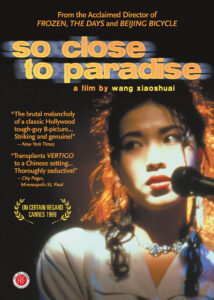
So Close To Greatness: The Movie, “So Close to Paradise”

0E6E27C3-322C-4A99-869D-2127CFD53546A terrific film noir produced in China, So Close to Paradise was made in the late Nineties, banned for three years by the Red government, and—hooray!—subsequently released in the U.S.  It didn’t make me think of Forties and Fifties Hollywood, though, but rather of the lofty Euro film of Antonioni and lesser artists, what with its angst, its silence and its careful visuals.  The “music” of the picture are the sounds of a tugboat, heavy rain, high heels on pavement and—well, sober tones.  Lamentably, serious cutting was done by the Chinese studio, but filmmaker Wang Xiaoshunai‘s talent still shines through.  The thin plot is quite digestible, and actress Wang Tong is lovely as she credibly plays a worldly nightclub singer.

A character called Gao Ping (Guo Tao), a man of greed and lust, is one of the film’s three losers.  The other two are Gao’s young pal Dongzai and Wang’s nightclub singer, Ruan Hong.  After his partner-in-crime makes off with Gao’s stolen money, Gao tracks down Ruan because she knows where the jerk can be found.  In fact he has to abduct her, and he rapes her.  Amazingly, the two become a couple (don’t tell the feminists).  Thereafter there is trouble.  Angst.  Also, however, the plot loses its hold on us (it did on me).  Only the technical sophistication begins to matter, but so be it.  I still had a good time with So Close to Paradise.

“The Bride Wore Black”: Truffaut Made Too Many Movies

The Bride Wore Black

The Bride Wore Black (Photo credit: Wikipedia)

Francois Truffaut admired the films of Hitchcock, but his thriller The Bride Wore Black (1968) is certainly more Truffaut than Hitchcock, which is wise.  However, this is the only good thing about the movie—an utterly lousy one.  It is much, much sillier than Truffaut’s The Woman Next Door, which nevertheless manages to satisfy.  Bride only manages to make us chuckle in disbelief, and somehow makes even Jeanne Moreau look (histrionically) bad.

The Anti-Monument Vandals

Cover of "M*A*S*H (Widescreen Edition)"

Cover of M*A*S*H (Widescreen Edition)

The fools among us are desecrating the monuments to Robert E. Lee, Thomas Jefferson and others.  I agree with the writer for The Federalist website who propounded that these monuments “mark our progress as a nation,” but this would never occur to the fools.  It’s only a matter of time in fact before they start destroying, if they can, massive copies of the Robert Altman movie, M*A*S*H.  This 1970 work is not only anti-military and anti-religion, it also denigrates homosexuals; and numerous young vandals won’t tolerate that.  For my part, I have never liked M*A*S*H, but I wouldn’t respect any grand removal of it from American venues.

Again, Wayne Is “Tall in the Saddle”

In the John Wayne Western from 1944, Tall in the Saddle, land seizures are interrupted when a man threatens to tell the authorities about the sell of marked playing cards.  The man, never shown, is killed.  John Wayne plays the newly hired worker and good shot who, naturally, discovers the truth.

Wayne plainly attracts the haters here, including an insufferable biddy.  A saucy cowgirl (Ella Raines) believes Wayne has made a fool of her, and she intends to fire him from his ranch job, but—aw—she becomes infatuated with him.  There is a pleasing little moment in Saddle when a fellow female looker, Raines’s competition, praises the cowgirl’s prettiness and Raines gives a verbal indication that she knows about her looks and intends to use them to her advantage.

Tall in the Saddle

Tall in the Saddle (Photo credit: Wikipedia)

Director Edwin L. Marin‘s movie is a fun romp in which Wayne’s character is refreshingly less contemptuous of certain people than some other Wayne characters.  The cast is not wholly effective but it comes close, especially with the admirable fire of Ward Bond and Miss Raines.

A Word About “Ordet” (The Dreyer Film)

Carl Theodore Dreyer‘s Ordet (“The Word”, 1955) is tedious and too theatrical—it is adapted from a play—but also sufficiently strange to end with an astonishing miracle the likes of which humanity never sees anymore.  The film shows us the persistence of religious faith despite what life does to ordinary hopes and pursuits:  possessing a sane mind, having a healthy family, getting married.  But it shows us, too, a madman who thinks he is Jesus Christ before he recovers his sanity (unlikely) performing the aforementioned miracle.  He necessarily performs it through the power of Jesus Christ (and certainly not through his own power).  Dreyer seems to believe that because God is able to create the universe, He can also work any kind of miracle, and he’s right.  His approach for conveying this, however, is not very palatable.

Page 181 of 316

Powered by WordPress & Theme by Anders Norén