Movies, books, music and TV

Category: General Page 268 of 270

Back to Lonergan’s Triumph: “You Can Count on Me” – A Movie Review

Laura Linney

The playwright Kenneth Lonergan has written and directed the 2000 You Can Count on Me, a decent motion picture about a brother-and-sister relationship.  Pleasant Sammy (Laura Linney) is a churchgoing small-town resident who works at a bank and is a single mother.  Her brother Terry (Mark Ruffalo) is a cordial if somewhat neurotic drifter, occasionally in trouble with the law, now paying a visit to Sammy and her 8-year-old son.  Since the two have long been orphaned, Sammy more or less wants to cling to Terry, her only sibling, and is troubled when she doesn’t hear from him.  Now, however, she is troubled by his ordinary irresponsibility, especially with respect to her son.  For one thing, he fails to pick him up from school on a rainy day.  Sammy, even so, unexpectedly turns into a moral wretch by practically abandoning a dating partner and carrying on sexually with her new, and married, boss at the bank (Matthew Broderick).   When she summons her pastor, Father Ron (Lonergan), to counsel the ne’er-do-well Terry, she is attempting to hide from her own need for spiritual service.

But such a thing can only be short-lived.  Sammy herself seeks counsel.  But Father Ron is a Protestant softie who offers theological wimpiness.  He is not quite what the adulterous Sammy needs, although he is right to put the following question to Terry:  Do you believe your life is important in the scheme of things?  Apparently he does, but will he ever behave in a way that confirms this view?  The movie is resolution-less, which is rather too bad.  It’s not about to try to answer any questions.  What it does try for, here and there, is a certain tidiness which is better left alone, even though–happily–it little mars the picture.  You Can Count on Me is a winner.

Lonergan’s script makes sense and its dialogue shines.  Linney and Ruffalo never make a misstep , though Rory Culkin, as Sammy’s son Rudy, is uninteresting.  As for Broderick, he is, I think, what John Simon called him in his review of the stage musical The Producers: “endearingly artful.”  Like many other American flicks, the movie is a bit too foul-mouthed but–bravo–it’s certainly far from foul.  Count on it.     

Re the Film Version of “Atlas Shrugged”

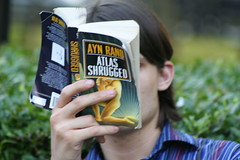
AynRand.AtlasShrugged.Dupont.WDC.25may06

Image by ElvertBarnes via Flickr

I need to see Atlas Shrugged, Part 1 (2011) a second time before I can make a suitable judgment about it.  I believe it to be weak in many ways, but as a motion picture it’s also unique and possibly acceptable.  (I have no interest in reading the Ayn Rand novel.)

“The business man is only tolerable so long as his gains can be held to bear some relation to what, roughly and in some sense, his activities have contributed to society.”  So wrote Lord Keynes, and the U.S. government in Atlas Shrugged, Part 1 must be espousing this view and seeing American businessmen as not contributing enough to society.  Hence it has turned to an anti-business crackdown.

I’ll see the film again much later, on DVD.

There’s Nothing Like “The Elementary Particles” – A Book Review

Michel Houellebecq (b. 1958), French writer

Image via Wikipedia

I’m not quite sure why French author Michel Houellebecq put a lot of sex in his novel, The Elementary Particles (2000) except that the book does impart the familiar message that no salvation lies in either sex or science.  Houellebecq’s two main characters are Michel, a scientist, and Bruno, a hedonist.  The author has no faith in liberalism or humanism either.   As for religion . . . well, he’s not without a certain respect for it (he gives Michel the insight that “materialism, having destroyed the religious faiths of previous centuries, had itself been destroyed by recent advances in physics”), but neither can he embrace thoroughgoing belief.

Mr. H.’s plotless novel is highly intelligent and occasionally funny but, all things considered, not one I can finally accept.  I’m rooting for him, though. 


“Bruce Almighty”? Damnation! – A Movie Review

”]Cover of "Bruce Almighty [Blu-ray]"

In 2003’s Bruce Almighty, God, played by Morgan Freeman, explains to Jim Carrey that if only people realized that not only God but they too possess power, they wouldn’t need to pray as much as they do and everything would be . . . whatever.  Never mind Bruce‘s theology:  it’s a big zero.  As is the hilarious but atrocious writing from Steven Koren, Mark O’Keefe and Steve Oedekerk.

A Buffalo, New York TV reporter, Bruce (Carrey) yammers about God and all the misfortune he faces until the Almighty, fed up, decides to endue Bruce with His own miracle might and see what kind of job he does as Supreme Ruler.  What he does for self-gratification is a howl, but it isn’t long before illogic and desultoriness stain the story.  So does sentimentality:  Bruce is the most syrupy comedy since Patch Adams (1998), both of which films were directed by the same man, Tom Shadyac.

Bruce Almighty raked in the almighty dollar when it was released, despite being a foolish wreck.

“I Served the King of England” & the 20th Century – A Movie Review

Cover of "I Served the King of England"

Cover of I Served the King of England

Czech filmmaker Jiri Menzel adapted, in 2008, yet another novel by Bohumil Hrabal–this time, I Served the King of England (with English subtitles).  Though I haven’t read the book, I find it impossible to doubt that it’s a very good film version, one for which a talented man is responsible.  Dark satire is here but no contempt for the characters, and a fun-loving style springs up, even to the point of exhibiting a peculiar, silent-movie mode for an early sequence.

Menzel’s hero, Jan Diti, initially sells hot dogs in Prague but aspires to become a millionaire; and moreover, working as a waiter for years, he does everything right.  Nothing is too challenging for him; he even brings ecstasy to the prostitute he beds.  But things go wrong, patently, after Jan meets Liza, a Hitler-loving German girl, with the hideous merger of Nazi-blessed religion and clinical science taking place.  And things go wrong after Jan finally makes his millions and Communists enter the picture.

Ah, well.  As a misanthropic, 60-year-old Czech professor tells Jan, “Man is the progeny of Evil [by “Evil” he does not mean God]–criminal and stupid.”  Indeed, the situation is “worse than that,” he says, because–and this is interesting–“all philosophers and prophets exclude Jesus Christ.”   Assuredly the film is about the (often efficient) enemies of civilization.

Plenty of artistic prowess is here.  In one scene, rich old men, while dining, gaze at a half-naked girl lying on a revolving platform.  Afterwards she quietly strips for head waiter Jan so the two plebs can have their own funtime.  Another bit of footage offers a shot of Jan and Liza sleeping in bed after lovemaking–the Czech fellow fully surrenders to the German woman–before the soundtrack produces a solemn radio announcement about Czechoslovakia’s late-Thirties surrender to Hitler.  And then there’s Menzel’s success at getting expert comic performances from his actors.  Ivan Barnev is buoyant and unself-conscious as a young Jan, Oldrich Kaiser is convincingly subdued as an aging Jan.  Julia Jentsch, as Liza, is a perfect political fanatic, listening without conscience to prophets who exclude Jesus Christ.

It will probably be a long time before I see another tragicomedy as palatable as the absorbing I Served the King of England. 

Page 268 of 270

Powered by WordPress & Theme by Anders Norén