Movies, books, music and TV

Category: General Page 202 of 271

Pixar’s “Inside Out”: Mostly Inside

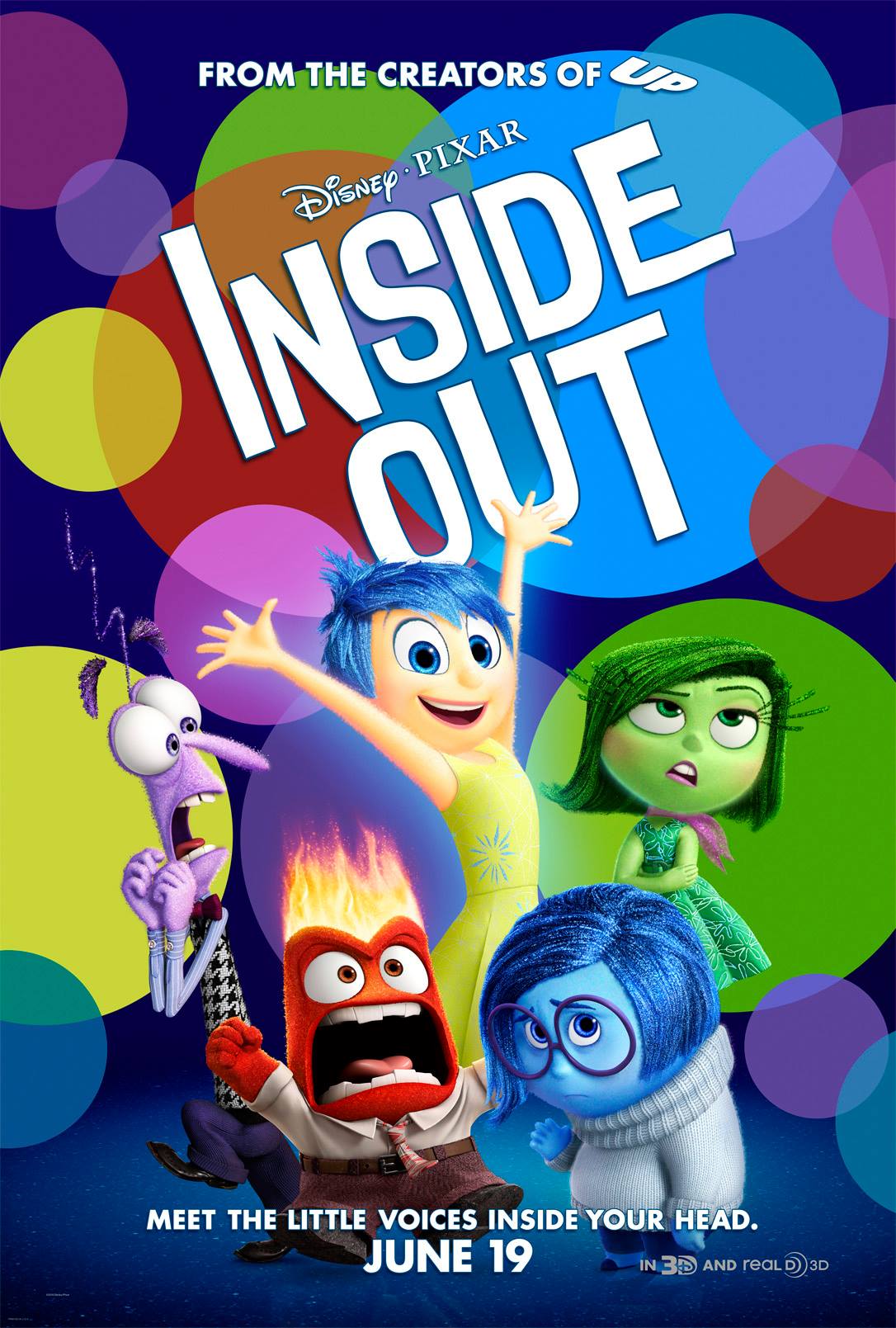
Disney-Pixar-Inside-Out-Movie-PosterThe new animated movie, Inside Out (2015), has the effect of instructing us that human beings are truly important.

This is not only because of their emotions—the inner being of the little girl Riley contains Joy, Sadness, Fear, Disgust and Anger, all personified—but also because (unlike animals) they have in their minds Abstract Ideas and are perfectly capable of critical thinking.  The latter is not reified in the film, but the former—Abstract Ideas—manifests itself when Joy and Sadness briefly lose their three-dimensionality.  See the movie and you’ll understand what I mean.

We are also told about the human subconscious—rather a letdown, this, since we don’t even know if the subconscious exists. . . But Inside Out in toto is no letdown.  It’s delightful.  It’s not merely for children; it may not be for children at all.  They do laugh at it, though:  I heard them in the audience.  One is obliged to point out that it is funny as well as deeply moving apropos of the need and love for family.

A moviegoer is unlikely to undervalue human beings, or human life, after seeing this smart Pixar film.


That’s One Needy Mother: The ’03 Film, “The Mother”

Roger Michell knows how to direct, and Hanif Kureishi is a serious screenwriter.  Early in their 2003 British film, The Mother, a cocky carpenter, Darren (Daniel Craig), meets and chats with an elderly man called Toots (Peter Vaughn) while ignoring Toots’s aging wife May, played by Anne Reid.  Subsequently we see dark scenes of a life winding down: Toots dies of a heart attack.

For her part, May feels lost, refusing to stay in her marital home, moving in with her fragile, unmarried daughter Paula (Cathryn Bradshaw).  Fairly desperate, Paula is crazy about Darren, a spoken-for man living apart from his wife.  Critic David Edelstein is right about the film’s reminding us that “neediness never dies.”  May’s doesn’t.  Correspondingly she too is drawn to the carpenter, and Darren learns of this.  The man who ignored her earlier now takes her to his bed, despite the big age difference.  Paula finds out about the betrayal, and naturally the result is more frustration, more self-pity, more suffering than have already occurred.

May and Darren do not genuinely conduct a love affair, and although May might be in love, Darren assuredly isn’t.  With anyone.  He has in common with May the fact that he is somewhat of a castaway.  Meanwhile, Paula believes she is simply a loser, no good at anything.  A self-absorbed loser, this woman.  And her mother, by the way, can be as decidedly selfish as Edelstein says she is.  These people are not angels.  They face their own wretchedness.  Kureishi does not let them off the hook.

The Mother cannot be acquitted of a certain sensationalism, or of unpleasantness.  Even so, it is a potent movie about impotence: May’s, Paula’s, etc.  It doesn’t have much of an ending, but the rest of it holds its own.  And, er, the sex stuff is well managed.  Before Reid’s breasts and Craig’s buttocks are revealed, the couple lie in bed, slightly out of focus, in the background while thin curtains fly in the constant wind in the foreground.  No sensationalism here, at least.

Cover of "The Mother"

Cover of The Mother


FYI, It’s C.O.D. : “The Bride Came C.O.D.”

A screwball item, The Bride Came C.O.D. (1941) is stale in several ways and obtuse in several others, but you could certainly do worse for sight gags and one-liners.

It tells of a charter pilot (James Cagney) hired by a tycoon to keep the latter’s daughter (Bette Davis) from marrying an unsuitable man.  The grand prevention requires the use of an aircraft. . . The best thing here is Davis, fully committed to her role.  Now classy, now sexy, she is also necessarily and beautifully buoyant.  As for Cagney, he was ever the cheerful man’s man; it’s no surprise that he finally became a political conservative.

Cover of "The Bride Came C.O.D."

Cover of The Bride Came C.O.D.


A Quick Look At “Tokyo Story”

An elderly couple visit their grown son and daughter and widowed daughter-in-law in Tokyo Story (1953), the great classic Japanese film directed and co-written (with Kogo Noda) by Yasujiro Ozu.

The couple’s children are harmless people who are nevertheless not as generous and attentive to their parents as they ought to be.  The daughter-in-law, Noriko, is generous and attentive.  Work and immediate family prevent the son, a doctor, and the daughter, a beautician, from experiencing the loneliness and isolation consistently imposed on the characters who have had, or are having, these life-enriching realities stripped away from them.  The parents are among these characters, and Noriko is too.  With scant opportunity to genuinely love her husband before he died in the war, she remains idiosyncratically loyal to the man but also secluded and not really living.  On this particular subject—loneliness and isolation—Tokyo Story, though a quiet film, is shattering.

(In Japanese with English subtitles)

Cover of "Tokyo Story - Criterion Collect...

Cover of Tokyo Story – Criterion Collection

“The Humbling” On Screen

I saw the film version of The Humbling (2014)—Philip Roth’s novel, which I reviewed on this site—on DVD the other day.  Barry Levinson directed the picture imaginatively and Al Pacino is extraordinary as the malfunctioning great actor who gets involved with the strange lesbian (Greta Gerwig), but the undertaking would have been better had the film been a little more faithful to the novel.

Buck Henry and Michael Zebede wrote the script, and I disesteem Henry’s attempts at arch comedy.  For a transsexual character, the ex-lover of Gerwig’s lesbian, to be tossed in is pointless, and the tragic ending is more garish, less believable, than Roth’s ending.  The film could have been a memorable success, but in truth it is too eccentric to even register as something disturbing and important.

Page 202 of 271

Powered by WordPress & Theme by Anders Norén