
Cover of Notre Musique
I want nothing to do with Jean-Luc Godard‘s Notre Musique (2004), which I had to see on DVD since it was never shown in a Tulsa theatre. No wonder. It has no entertainment value despite a few moments of striking insight, and its middle section is interminable. Without being otherworldly, its three sections correspond to the Hell, the Purgatory and the Paradise in Dante’s Divine Comedy, but it makes its points through exposition, not drama. So it’s talky—a talky elegy for a war-afflicted world.
Godard himself appears in the film, posing as the indubitable Intellectual Of Cinema. After lecturing at a literary conference in Sarajevo, during “Purgatory,” someone in the audience asks him whether little digital cameras will ultimately “save” cinema. Frowning like Laurence Olivier, Godard sits and never answers; and, yes, even though it’s a stupid question, the scene is smugly patronizing.
Now, the politics. A Jewish girl, Olga (Nade Dieu), martyrs herself in protest against Israel’s aggression toward the Palestinians. Godard has a right to his views about Israel, but he’s far more seduced by leftist tunnel vision about the country than by a cautious appreciation for history and present complexity. When he made this film, did he not care a whit about Ehud Barak’s concessions to the Palestinians in 2000? Was he aware of them? He makes a comment in the movie about non-revolutionaries: “Humane people don’t start revolutions. They build libraries.” “And cemeteries,” another man chimes in. (Oh, dear.) Of course Godard has forgotten that in these cemeteries there are plenty of Israeli civilians killed by Palestinian terrorists. Twenty-six of them died in 2002 at a Passover celebration in Netanya.
Notre Musique is the worst kind of art film: offbeat but also a myopic bore.


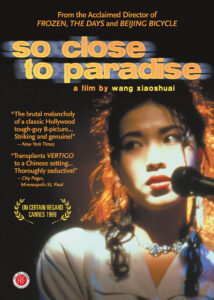 A terrific film noir produced in China, So Close to Paradise was made in the late Nineties, banned for three years by the Red government, and—hooray!—subsequently released in the U.S. It didn’t make me think of Forties and Fifties Hollywood, though, but rather of the lofty Euro film of Antonioni and lesser artists, what with its angst, its silence and its careful visuals. The “music” of the picture are the sounds of a tugboat, heavy rain, high heels on pavement and—well, sober tones. Lamentably, serious cutting was done by the Chinese studio, but filmmaker Wang Xiaoshunai‘s talent still shines through. The thin plot is quite digestible, and actress Wang Tong is lovely as she credibly plays a worldly nightclub singer.